As Europe Faces Unprecedented Employee Disengagement, Here’s How Founders Can Look Beyond Corporate Jargon to Create Lasting Cultural Change
Now is the time to find creative, authentic ways that connect with employees.
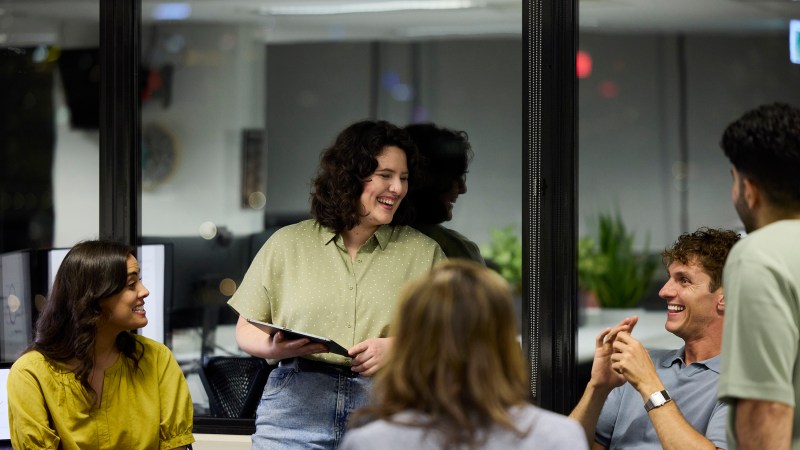
Morsa Images | Getty Images
Non-binary business professional enjoying with male colleague. Entrepreneurs in business meeting at office. She is holding digital tablet.
Opinions expressed by Entrepreneur contributors are their own.
You're reading Entrepreneur Europe, an international franchise of Entrepreneur Media.
When it comes to artificial intelligence (AI), the technology is helping us create powerful new tools that are changing the way businesses operate across industries, while opening up access to analytics, automation and generative tools.
Today, the European Union in particular is on the forefront of AI adoption, with its countries boasting the highest rates, according to a new report from Microsoft.
At the same time, the disruptive nature of the technology is also breeding feelings of uncertainty and instability during these volatile times. Gallup’s State of the Workplace report for 2025, for instance, showed that employee engagement rates are falling rapidly, costing the world economy $438 billion USD in lost productivity.
The report found that Europe had some of the lowest employee engagement rates last year, with 73% of employees in the region classed as disengaged and 15% as actively disengaged.
While we can look to examples of corporate brands that have achieved incredible success when re-writing the corporate playbook for company culture, these examples only achieved these results because they didn’t try to follow pre-existing trends.
In short, the most impactful company cultures are ones that transcend the hype and leave corporate engagement buzzwords in the boardroom. The real differentiating factor in the era of AI, then, lies in an approach that is built on trust, identity, and human culture.
Here are three lessons that can help all leaders find authentic ways to improve their company culture during these uncertain times in the age of AI.
When it comes to developing people-driven cultures, creativity beats resources
While it’s important to recognize how deeply employee disengagement can affect overall business performance, lost productivity is just one of the many signs that a major disconnect is at play.
Bottom line, disengagement impacts is a late-stage consequence of weak company foundations – and it can take years before it directly impacts on profitability.
Paradoxically, companies won’t build meaningful change in corporate culture if they approach the problem through the black-and-white lens of profitability.
Leaders should strive to build an engaged and connected workforce, not because of its impact on productivity, but rooted in the simple desire to foster a company that is genuinely a great place to work.
In prioritizing creating an excellent workplace environment, the doors will be open to creative thinking. And, in my years of experience – from working at Microsoft to building companies – I’ve also seen that the best results are not always those with the biggest budgets.
Multinational corporations often have significant resources at hand to invest in employee engagement initiatives, yet employees can easily spot inauthentic campaigns. Often, the end result is an expensive project that further erodes trust and morale, doing the very opposite of its intended purpose.
The good news here is that this is a creative approach that often wins out. What started off as a crazy idea, for instance – building musical festivals within enterprises – today has involved global brands such as Cisco, Siemens, BNP Paribas, Nokia, Bosch, Microsoft, and others, across multiple international cities, including Lisbon, London, and Berlin.
What makes this especially relevant today is that this impact was built without large agency structures or heavy resources — something that, even with all their scale, many global agencies struggle to achieve.
At the end of the day, creativity triumphing over resources is a positive for the ecosystem because it means companies of any size can generate results without the need to commit massive overheads to the challenge.
Company culture isn’t always scalable – this is okay
In the age of AI, we’re living in the era of automation and scalable results – I’ve seen the rise of AI-powered employee engagement tools that help HR teams manage things like internal communications or team shoutouts.
But, while these can be helpful at a time of distributed global teams, looking at metrics from software platforms as metrics of success is not likely to have as much impact on true levels of engagement.
In other words, seeing that employees have read a memo certainly does not mean the message has been received.
I established Brands Like Bands in 2008 and created the first edition of our festival in 2013, long before employee branding had turned into the latest buzzword in the boardroom and employee engagement itself turned into its own industry.
One of the things I found even more important than the breadth of impact of HR initiatives is its depth. For instance, I would rather have an initiative truly impact 10% of team members versus more breezily reaching 80% of a workforce, for example.
In 2026, I urge leaders to look beyond engagement KPIs and stop trying to scale what works through heavy corporate structures that demand high levels of resources. If employees have to be strong-armed into attending a meet-up or an event, the experience will not be positive, regardless of how many team members attend.
Instead, companies need to find what resonates with individual teams in specific locations in order to find projects that go beyond hype or buzzwords.
It’s important to build with consistency, but this does not mean we need to cut and paste the same idea. For one, Harvard Business Review found that 72% of culture initiatives led to no improvements as employees felt they were superficial, while 57% of employees felt worse following the launch of culture-building perks – viewing them as a band-aid for deeper challenges.
The importance of co-creation during company change
In our current era of uncertainty, the need for co-creation becomes paramount.
Any instance of company-wide change can become a source of frustration for employees that breeds disengagement and detachment. However, change has become inevitable and companies have a duty to make high-level decisions that preserve the sustainability of the firm.
While working with global organizations across industries over the past decade, I’ve seen firsthand that cultural initiatives fail not because people resist change, but because they are rarely called upon to co-create it.
Here, we look to the rise of remote work as a good example. More than three-quarters of Gen Zs and millennials said they would consider looking for a new job if asked to go back to the office full-time; according to a report by Fortune, for the first time since the pandemic, individuals stated that they preferred hybrid over remote work.
In reality, going back to the office may be needed for some teams to generate the best results. If a new policy is announced without any consultation from the affected employees, the removal of a benefit that is widely seen as positive will create disengagement and detachment from the company.
However, if employees are viewed as equal stakeholders during the process and used to co-create a new office policy, it is much more likely that the change will be met with less resistance when it’s rolled out.
Change is unavoidable, but co-creation can help to ensure these fluxes do not erode engagement rates even further.
There is no secret formula to company culture
If there is one thing I’ve learned working alongside brands to reimagine their corporate culture, is that there is no secret formula to getting results.
Not everything is going to work, and there is no guaranteed way to generate impact or create lasting loyalty with employees. But, now is precisely the time to find authentic ways that connect with employees.
Ultimately, this may be what matters most.
When it comes to artificial intelligence (AI), the technology is helping us create powerful new tools that are changing the way businesses operate across industries, while opening up access to analytics, automation and generative tools.
Today, the European Union in particular is on the forefront of AI adoption, with its countries boasting the highest rates, according to a new report from Microsoft.
At the same time, the disruptive nature of the technology is also breeding feelings of uncertainty and instability during these volatile times. Gallup’s State of the Workplace report for 2025, for instance, showed that employee engagement rates are falling rapidly, costing the world economy $438 billion USD in lost productivity.