The EU Can Still Catch Up with the Likes of North America and Asia in the Great AI Buildout
The European Union is strategising an AI infrastructure buildout to match global leaders in North America and Asia.
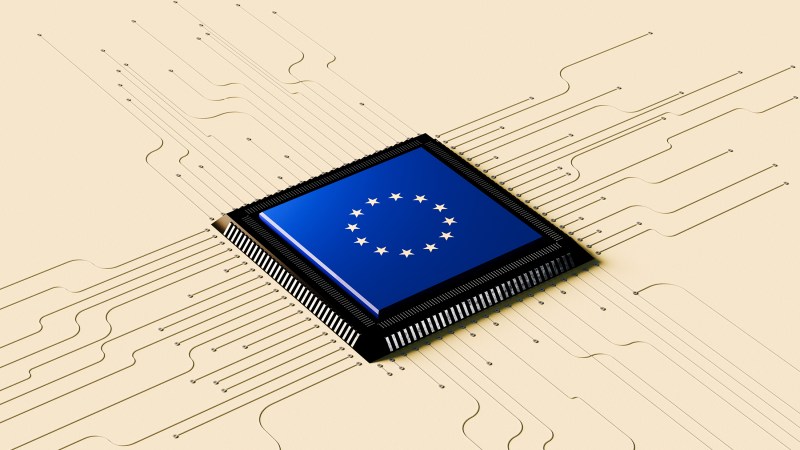
J Studios | Getty Images
Opinions expressed by Entrepreneur contributors are their own.
You're reading Entrepreneur Europe, an international franchise of Entrepreneur Media.
The artificial intelligence landscape is evolving at a rapid pace, and European entrepreneurs have long sought out indications that the EU is strategising an AI infrastructure buildout to match global leaders in North America and Asia, but is it possible to catch up to the emerging high-tech juggernauts?
UNCTAD insights suggest that the AI market will reach a value of $4.8 trillion by 2033, underlining the sheer scale of the opportunity currently presenting itself to businesses throughout Europe.
However, the buildout has been slow to kick into gear so far. Estimates suggest that the EU currently has around 5% of the world’s total AI computing power, compared to 74% in the US and 14% in China.
Despite this, Europe holds plenty of advantages when it comes to harnessing the power of artificial intelligence, and the continent has seen a heavy flow of AI research papers that’s helped to foster innovation and effective regulation locally.
The European Union’s Artificial Intelligence Act has served as the world’s first comprehensive legal framework on AI, and it addresses risks associated with the technology while protecting Europe’s potential to play a key role in developing use cases.
However, it’s proving difficult to compete with Wall Street’s sprawling big tech companies and their astronomical capital expenditures that are paving the way for AI infrastructure projects at scale.
Data suggests that the ‘Magnificent Seven’ collective of the largest stocks on the S&P 500 have committed $700 billion towards AI buildouts in 2026 alone, with $400 billion spent last year.
In Asia, China is also a formidable competitor for its ability to rapidly deploy and scale the technology, and the nation’s plans to become an AI superpower by 2030 are set to make the race to become a market leader all the more challenging.
So, how is Europe fighting back in the battle for AI dominance? Let’s take a deeper look at the EU’s plans to support high-tech innovators through its own intelligent buildout:
Becoming an AI continent
Europe may have some ground to make up on its rivals, but there’s plenty of evidence that the continent can become a leader when it comes to artificial intelligence.
Critically, the AI Continent Action Plan has sought to position Europe as a key location for rapid industrial competitiveness while still balancing human-centric values in its tech rollout.
Last year we saw the European Union Commission announce a major expansion of the continent’s AI infrastructure, with six new factories joining a network of existing locations, creating a total of 19 artificial intelligence factories throughout 16 Member States.
This sprawling range of AI factories has been supported by over €500 million ($569m) in joint investment from the EU and Member States, and the third wave of AI factories will not only expand the continent’s high-performance computing capabilities but will also accelerate the uptake of AI among innovative businesses.
By the end of 2025, more than €2.6 billion ($3bn) had been committed by the EU and participating EuroHPC countries towards the AI Factories and Antennas initiative, helping to form a catalyst for further growth.
This year has seen momentum grow further, with a total of €221.8 million ($252m) dedicated to the initiatives focused on the development of trustworthy AI services, innovative data services, and the securing of strategic autonomy for the European Union.
The funding will support entrepreneurs contributing to different artificial intelligence developments, including the Apply AI Strategy, robotics, quantum technologies, photonics, and virtual worlds.
An additional €85.5 million ($97m) has been made available for supporting open strategic autonomy in digital and emerging technologies and raw materials.
Symbiotic innovation
Europe may have a closing window of opportunity to catch up with its global AI rivals, but one of the biggest strengths to the rollout of artificial intelligence initiatives throughout the continent is the melting pot of innovation that can support fresh use cases that have the potential to quicken an infrastructure buildout.
When it comes to the construction of data centers, data has shown that nine in 10 workers are still bogged down in using spreadsheets and paperwork to overcome silos that will be eliminated with agentic AI and machine learning (ML) analytics.
The deployment of sovereign AI capabilities throughout key sectors will help European entrepreneurs to develop and control critical AI strategies that can provide greater flexibility in national, economic, operational, and technical independence.
The future of AI in Europe
Europe may lack the capital expenditures and rapid scaling initiatives of the world’s leading AI continents, but the European Union has already shown that it can be a trailblazer in artificial intelligence R&D.
While this could see the continent miss out on a first-mover advantage, it means that Europe has the potential to out-innovate its peers to become an AI powerhouse in a more sustainable and ethical way.
The window of opportunity for the EU won’t be open forever, but a more conducive environment for growth may well see Europe gain plenty of ground as the brave new world of AI continues to become more accessible.
The artificial intelligence landscape is evolving at a rapid pace, and European entrepreneurs have long sought out indications that the EU is strategising an AI infrastructure buildout to match global leaders in North America and Asia, but is it possible to catch up to the emerging high-tech juggernauts?
UNCTAD insights suggest that the AI market will reach a value of $4.8 trillion by 2033, underlining the sheer scale of the opportunity currently presenting itself to businesses throughout Europe.
However, the buildout has been slow to kick into gear so far. Estimates suggest that the EU currently has around 5% of the world’s total AI computing power, compared to 74% in the US and 14% in China.

Dmytro Spilka • CEO and Founder of Solvid
Entrepreneur Leadership Network® VIP
Dmytro is a CEO of Solvid, a creative content creation agency based in London. He's... Read more